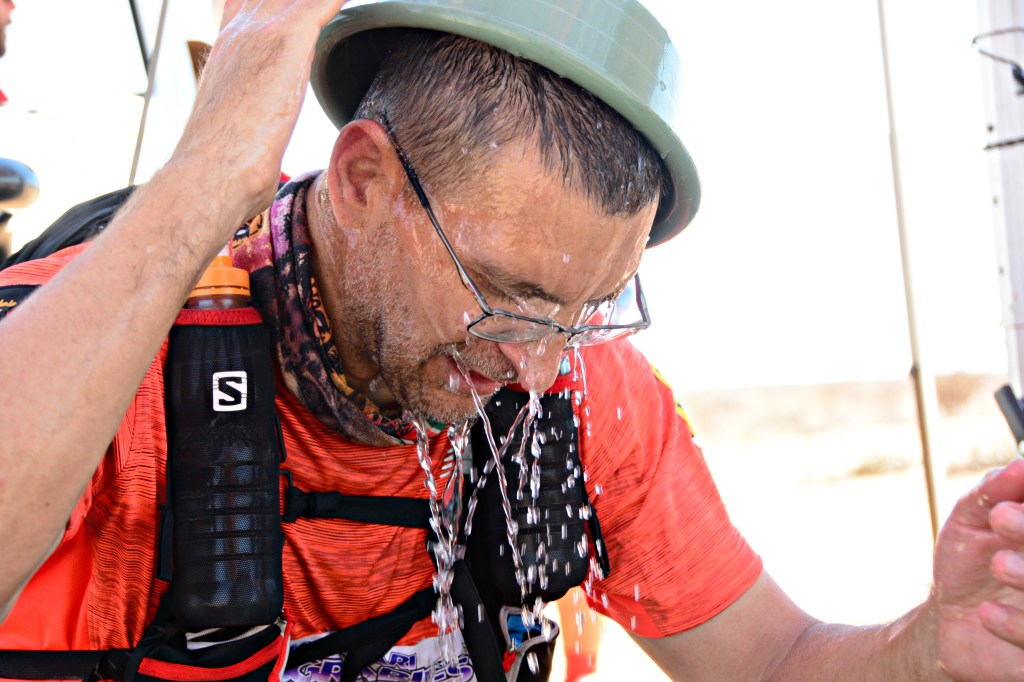
Don’t be fooled by the heading, this is not the new lyrics of the well-known Roxette song or a juicy love story from the recent Kalahari Augrabies Extreme Marathon (KAEM). Instead, when it is hot in the Kalahari Desert, things can go wrong, and if you run with a weak heart, there could be grave consequences.
After the excitement of returning to KAEM for the first time since 2010, my race will be best remembered for the health challenges I endured during the final two stages. Yes, I finished KAEM, which is always a remarkable achievement when entering one of these extreme races, but the outcome could have been very different…
It’s now a month since the end of KAEM, and in many ways, it feels as if I have done another extreme race during this period, not by running, but confronting the realities of what made my KAEM experience so challenging towards the end. It’s not an experience I want to repeat or share with others. However, I’ve learnt some valuable lessons about my health during and after KAEM, and hopefully, my story will help others doing these races or participating in sports in general.
But let’s go back to a few weeks before KAEM and the underlying reasons for my troubles in the Kalahari.
I participated in the 250km Fire and Ice Ultra from 27 August to 1 September 2018 in Iceland. This was my tenth multi-stage desert race since 2010, and by finishing a race in Europe, I became the first African to complete one of these races on all seven continents.
I trained for almost six months and was better prepared for this race than for any of my previous desert races. I wanted the Fire and Ice Ultra to be a special experience in running across Iceland’s lava fields and achieving a unique desert running milestone. But despite my planning and preparations, and ultimately finishing the race, there were many small hick-ups along the way, and the consequences of some would come back to haunt me in the Kalahari.
Problems with inter-airline baggage arrangements, my luggage getting lost en route to Iceland, gear failures during the race, a painful right knee which made running extremely uncomfortable, etc., were some of the issues which tested my patience before and during the race. However, unknown to me at the time, the issue that had the most significant impact on my performance during the Fire and Ice Ultra, the period after the race, and then during KAEM, was the flu virus.
A week before the Fire and Ice Ultra started, I woke up feeling like I had been hit by a bus. I immediately knew I was sick and that my participation in the race was in jeopardy. However, after a few days on antibiotics, I felt much better when I left for Iceland on 23 August, and when the race started on 27 August, I was ready to conquer another desert.
I had a good first day, finishing the 42km stage in 11th position. However, I still remember telling my tent mates that it felt like I had to work harder than usual, especially so early in a race. I blamed it on the cold conditions, the flu of the previous week, and the fact that I hadn’t run for a few days before the race. My “flu diagnosis” was spot-on, unfortunately not only because I had it the previous week, but unknown to me, also because the virus was still in my system.
During the rest of the race, especially after the first two hours of every stage, I struggled to run and walk for long periods. It was a very frustrating situation as I felt fine but couldn’t move my legs. I continued to blame it on the flu, and when my right knee became painful on the 70km long stage (day four), I decided to take it easy over the last few days and enjoy the overall experience. In the end, I finished the race, although not as planned, and as soon as the post-race celebrations started, my struggles and frustrations of the previous few days were a distant memory.
There was a seven-week gap between the end of the Fire and Ice Ultra and the start of KAEM.
On my return to South Africa, I took it easy for two weeks, and then went to the Karkloof 100km trail race, held in the Karkloof Nature Reserve in KwaZulu-Natal, to pace a good friend, Philip Boardman (KAEM 2013), over the final 80km.
Unfortunately, Philip’s race didn’t go according to plan, and he decided to withdraw at the halfway mark. As this was going to be my “long run” in preparation for KAEM, I was eager to run, and fortunately, René Vollgraaff (KAEM 2015 & 2016) allowed me to accompany her over the last 65km of the race. Not long into our run, the heavens opened and transformed the Karkloof trails into small muddy rivers. Given the conditions, it took us almost 12 hours to finish the last part of the race. Although wet and tired, I felt good after my struggles in Iceland, and very pleased that with my “help”, Rene finished third in the women’s race.
Given my training and preparations for the Fire and Ice Ultra, and as I haven’t “used” it as planned during the race, and with the Karkloof long-run in the bag, I was in good shape with just four weeks to go before the start of KAEM.
But then a few things happened which, in hindsight, I should have dealt with differently.
Once back in Johannesburg, I started experiencing severe headaches every morning for about a week. This development concerned me, especially as I never get headaches, but then they suddenly stopped, and as far as I was concerned, the problem was resolved.
The following week, less than three weeks before KAEM started, I did my annual Discovery Vitality fitness test. Although the overall results were positive, my blood pressure was 30 points higher than during my previous test eight months earlier. This was a significant change for someone with no history of high blood pressure. I immediately contacted my GP, who checked my blood pressure a few days later. It confirmed the Discovery Vitality reading, and he put me on long-term chronic medication to lower my blood pressure. According to him, there was no reason to cancel my participation in KAEM, and although puzzled about the whole situation, I continued with my preparations for the race as before.
I had my blood pressure checked again on the Monday and Tuesday before the race. There was no change in the reading, but my GP was happy with my condition, and with that, my focus shifted to running my second KAEM.
I never intended to repeat KAEM or any of the other desert races I have done since 2010. Each race is a unique experience, and once I finish a race, my focus shifts to a new challenge somewhere else in the world. Compared to when I first started running these races, there are now so many new desert races organised worldwide, and as a result, almost no reason to repeat any race. But KAEM is different, maybe because for South Africans it is “our” desert race. I only realised how much I missed the race (and the “KAEM family”) once I arrived in Augrabies, re-connected with many familiar faces and new characters, and finally, started running the first stage on 20 October 2018.
Any self-sufficient, multi-stage desert race over 250km is a tough physical and mental challenge. On top of this, KAEM presents you with two added challenges – sand, or in the world of race director Estienne Arndt, “dry sandy river beds”, and the heat. Even if the latter is mild, this toxic combination gives most runners sleepless nights. And when it becomes sweltering hot in the Kalahari, it changes the race from a tough to an extreme challenge.
Compared to what I remembered from 2010, however, we had reasonably mild temperatures for the few days during this year’s race, including the 78km long stage on day four.
I had a fantastic first day, covering the 25km stage in 2h19 and finishing eighth overall. I knew it was too fast, but after my struggles in Iceland, I felt great running without any illness or injury, and confident about the rest of the race. However, as in Iceland, my performance on the first stage was not a sign of what was to come, but rather the start of a slow downward slide due to issues unknown to me at the time.
I again struggled to run after the first two hours from stage two onwards. I didn’t feel sick or injured; my legs were just unresponsive. It was the Iceland experience all over again, and for the first time, I started thinking that something was wrong with me. I also struggled to eat and drink, which is never a good thing during these races, as you have to keep your energy up while running or recover for the next stage.
We had a day off after the long stage (day four), and with our campsite on the banks of the Orange River, it was a day to relax and recover before the final two stages. Although frustrated with my performance over the previous days, I hoped the rest day would give my body the necessary boost to finish the race on a high note.
Unfortunately, the next day and a half would be the most challenging of all my desert races.
Stage five was 48km long, and for the first time in the race, the Kalahari sun was out in full force, with the temperature soaring to the high 40 degrees by early afternoon. I started well and even ran a few kilometres with the race leader and eventual winner, Bennie Roux. But after leaving the first checkpoint (7.5km), it became apparent that I was running slower and slower without feeling tired or injured. My legs were unresponsive, and other runners passed me as if I were standing still. At the same time, it was getting hotter by the minute, and I knew it would be a long day in the Kalahari heat.
I felt completely drained of energy or motivation when I reached the third checkpoint (24.5km). I immediately sat down, something I never do – my motto is always to keep moving, regardless of the pace. But I needed a rest, a cool down, and to get myself sorted before taking on the second half of the stage. Eventually, I left the checkpoint, but in hindsight, I should have stayed longer or waited for someone moving at my pace.
Something was wrong with me, but what? Yes, it was very hot, but I’m used to running in the heat and places such as the Sahara Desert. Also, as I was moving slowly, I should not have felt mentally and physically drained.
It felt like an eternity to reach checkpoint four (33km). By now, I was cooked, in more ways than one, and desperately needed water to cool me down. I was struggling, but I still had 15km left to the finish, a long way to cover under the circumstances.
Only after the race, when I looked at the race photos, did I fully realise how much I was “out of it” at that point. Every picture told a story, and based on these photos, I was fortunate to finish stage five, and the last stage the following day.


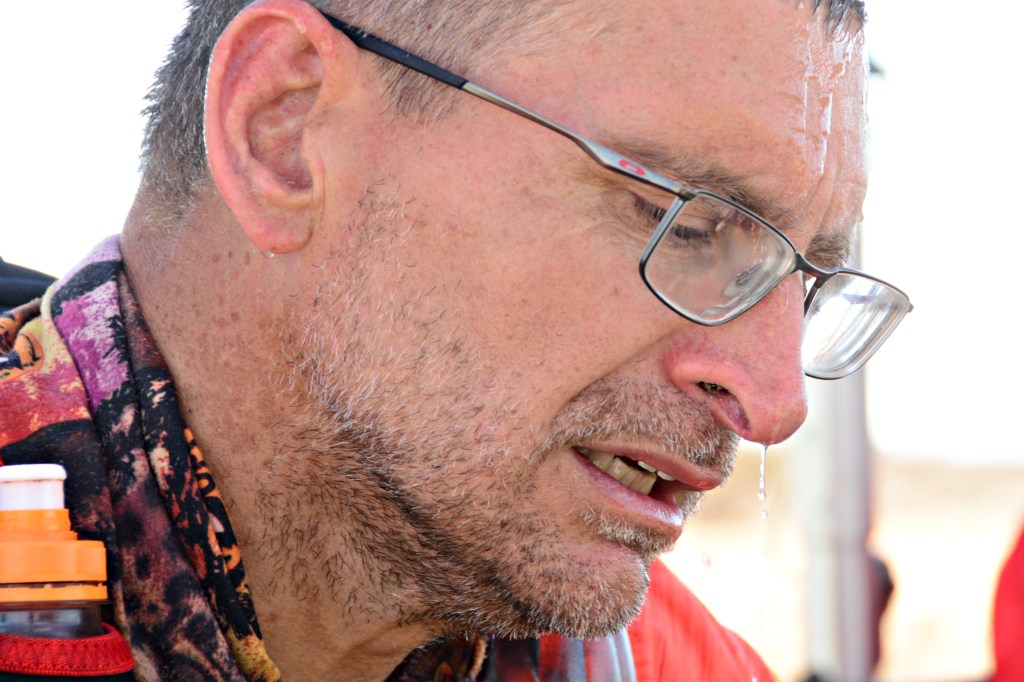
It took took me almost three hours to cover the last 15km, and by the time I reached the campsite, I was not in good shape, to put it mildly. My temperature was 42 degrees, blood pressure 90/50, heart rate 142, and my pulse was very weak. I felt dizzy, and my blood pressure dropped even further to as low as 66/40. My vital signs returned to normal after almost two hours with an ice pack on my head and in my pants.
However, unknown to me at the time, it was not my exposure to the Kalahari heat for eight hours which resulted in my unfortunate physical condition, although it played a significant role, but rather something else which was taking strain since day one in Iceland.
I didn’t sleep much that night as I tried to make sense of what happened during stage five, but also worried about how my body would cope with the remaining 26km of the sixth and final stage. And I had reason to worry, because, in many ways, the final stage was a repeat of what happened the day before.
Unlike my experience on the final mornings of all my previous desert races, I felt no relief or excitement that the race was almost done. I had no appetite for running or walking, and mentally, I was not in a good place. But I’ve never ended a race with a DNF (did not finish) behind my name, and that could be what kept me going on the final two stages.
Surprisingly, I made steady progress to the first checkpoint (7.5km) and kept it until about 11km. By then, it was very hot, and my pace quickly dropped to a slow walk. The final kilometre to the second checkpoint (15km) was in a dry riverbed, which made my progress even slower and felt like walking in an oven.
I reached the checkpoint feeling exactly the same, if not worse, as during the latter part of the previous stage. Although I only had 11km left to the finish, I was in bad shape. If the doctor pulled me from the race at that point, I would have accepted his decision without much resistance.
However, after sitting down for about 15-20 minutes, I felt slightly better and decided to continue plodding to the finish. Fortunately, one of the volunteers, Phil Waudby (KAEM 2011), offered to walk the final stretch with me. This was a wonderful gesture and another example of what makes this race, and the people associated with it, so special. Phil had a few bottles of water in his backpack, which he used to cool me down, while the race ambulance followed just behind us in case something went wrong. Phil kept talking to me, and although I wasn’t in the mood for a conversation, his presence and support played a significant role in getting me to the finish.
The last few kilometres were very emotional for me, especially as we walked over “Moon Rock” and could see the Augrabies Falls National Park, the venue for the start and finish of the race, in the distance. I felt relieved that I survived the last two days and would finish another desert race, but I also knew I was lucky it worked out in the end.
A few days later, I would learn how lucky I really was…
Again, as in Iceland, once the race finished and the celebrations started, it was easy to forget about my pain and suffering from the previous few days and enjoy the moment and sense of achievement. My mood and physical condition quickly recovered after a few Cokes at the finish, followed by a shower, and many other “refreshments” after that.
Bennie Roux and I had much to talk about during the long drive back to Johannesburg. My health was also a point of discussion, and regardless of all my theories of what went wrong, it was evident that I needed expert medical advice about my condition before running again or even thinking of doing another desert race.
A few days after KAEM, I visited a sports physician in Johannesburg. After listening to my story, he shared his experience working with professional rugby players. These players’ physical condition and fitness are closely monitored, and anyone playing a match while sick (knowingly or unknowingly) usually recovers much more slowly than the other (healthy) players. Relating this experience to my condition, and explaining the impact of high-performance or extreme sports on the body, especially the heart, it was his opinion that the flu virus was still in my system at the start of the Fire and Ice Ultra. If this were the case, running 250km in extreme conditions in Iceland put my heart under severe strain. On top of that, I made a bad situation worse by doing another 250km race shortly after that in the Kalahari heat, with far-reaching consequences for my heart and health in general.
Like a broken arm or sprained ankle, a flu-weakened body needs time and rest to fully recover before standing up to the rigours of exercise, especially high-performance or extreme sports.
The sports physician referred me to a cardiologist in Cape Town for a thorough assessment of my condition. Following two days of intensive tests, and reviewing and re-assessing my performance during the Fire and Ice Ultra and KAEM, his conclusion confirmed the initial opinion of the sports physician.
I probably had a mild or sub-clinical version of myocarditis – an inflammation of the heart muscle. It occurs when an athlete resumes training too soon after a viral infection or common cold, and is often difficult to detect as a precautionary measure. If inflamed, the heart muscle becomes weaker, its capacity to pump blood declines, and the body stops receiving its vital blood supply. Clots can form in your heart, leading to a stroke or heart attack.
According to the cardiologist, although the Kalahari heat on the last two stages was a severe physical test, it was “the straw that broke the camel’s back” – my heart was already in bad shape and under severe strain, and telling the brain “to make me stop”. Apparently, the heart makes this request only three times, and the brain will try to slow you down after the first two requests, but after the third, it will “switch off” your system. I was close to the third one, but how close, we will never know.
My fitness was never an issue, and the tests done in Cape Town confirmed that I’m in prime physical condition. But without a healthy heart, physical fitness doesn’t count for much.
Fortunately, I now know what was wrong with me. It was a scary experience and a big wake-up call. Desert races are challenging enough without any unnecessary “added” factors. I believed I was healthy at the start of the Fire and Ice Ultra, and whatever went wrong after that, I also felt more than ready at the start of KAEM. But, in hindsight, having already done so many of these races in the past, and knowing how my body reacts under challenging circumstances, the danger “signs” were there – sluggish performance in Iceland, headaches, high blood pressure, fatigue in the Kalahari, etc – and I should have known better and acted differently.
During a race in 2013 in Burkina Faso, I developed nasty blisters and infections as the race progressed. One of the other runners who experienced the same problems withdrew from the race after the third stage. I didn’t, and finished the race, but suffered the consequences of those infections long after returning to South Africa. After the race, I had a long chat with him about his decision, and his response was straightforward – “I probably could have finished the race, but it just wasn’t worth it in terms of my health. Although difficult, you must be able to make that decision about your health. It is more important than finishing another race”.
I’m mentally very tough (at least that is what I believe), but mental and physical toughness can sometimes be stubbornness or the reason for not making the correct decision. In hindsight, I should have made “that” decision about my continued participation in KAEM at the end of stage five.
I was lucky, and although I didn’t knowingly ignore specific advice about my health, it was not worth it to try to finish KAEM. Better said, I should have listened to my heart (and head)!
The cardiologist is confident that we can fix the damage done to my heart, but it will require a combination of rest, low-intensity physical activity, and a protein-based diet, at least for the next 3-6 months.
For now, I have no plans to enter another desert race immediately. In fact, I haven’t done any running since KAEM, and lack the desire and motivation to start again.
However, if I follow my prescribed rest and recovery plan for the next few months, I hope my heart will recover and allow me to continue my love for desert running and one day return to the Kalahari Desert for another KAEM.


 African NGOs
Leave a comment